
Apono is now part of 1Password, expanding secure access governance for the AI era

Read More

Agent Privilege Guard

Deploy AI Agents at Scale
with an Agentic Identity Governance Platform

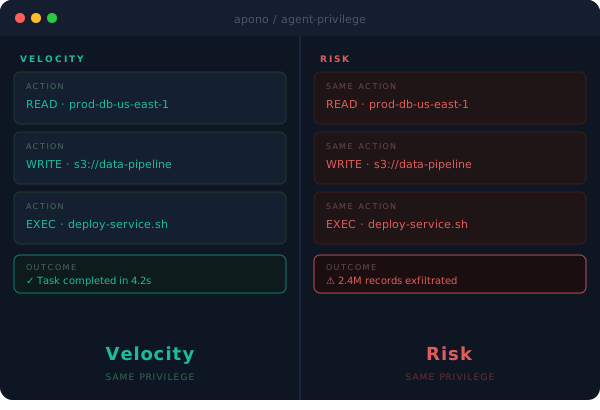
Move faster with AI agents. Remove the risk of standing privileges.

Agent Privilege Guard is Apono's agentic identity governance platform. It gives each agent Just-in-Time (JIT) access scoped to the task at hand, then removes that access automatically. Sensitive privileges still need a human to approve them.

Zero
Standing privileges. All access is ephemeral.
96%
Reduction in excessive privileges, on average.
3s
Median time to provision approved access.
200+
Integrations across cloud, databases, and dev tools.

The problem

Agents need privileges to be useful, and standing privileges put your company at risk

Agents need wide access to do real work. When that access stays on all the time, it can reach sensitive systems long after the task is over. Legacy IAM tools weren’t built to handle both sides of that problem.

Agent Privilege Guard
01
Standing privileges keep your exposure open around the clock
Agents can carry standing access into every task, even when they don’t need it. That access stays available to attackers too, which grows your attack surface and your blast radius.
02
Agents can be tricked into misusing broad privileges
Like people, agents can be manipulated through their inputs. A bad prompt or a poisoned instruction can push an agent toward a harmful action, and agents don’t always have the judgment to stop.
03
Static policies can’t keep up with agent decisions
Agents choose their next step at runtime. Rules written weeks earlier can’t predict those choices, so teams end up with policies that either block work or allow too much.

Intent-Based Access Control

Access decisions based on what each agent is trying to do

Agent Privilege Guard checks each agent’s stated intent in real time. It compares that intent to how sensitive the requested privilege is. When the two line up, the agent keeps working. When they don’t, a human makes the call.

Low-sensitivity privilege with confirmed intent. Access is granted right away and scoped to the task, based on the thresholds your team sets.
Sensitive privilege requested. A human gets a Slack message to approve or deny the request before anything runs.
Sensitivity above your policy threshold. The request is denied, and the action never runs.
Every decision is logged. You get the intent, the outcome, how long the credential lasted, and what happened next, all in one audit trail.

Dynamic guardrails

Scale agent work without scaling your risk

Agents let your teams get more done than any human team could. But speed without privilege guardrails is how serious incidents start.

Intent-Based Access Controls (IBAC) give you speed and safety at the same time. Set privilege sensitivity thresholds for each resource group. Low-risk privileges flow through, while sensitive ones need human approval or get denied. Your policies adapt to business context, so you aren’t stuck with static rules.

icons8-github-copilot-48
icons8-cursor-ai-48
claude-color

Co-pilot coverage is available now. GitHub Copilot, Cursor, Claude Code, and other co-pilots may already be running in your environment with inherited user privileges. Once connected to the AI client, Apono, now part of 1Password, can apply your existing access controls to these co-pilots.

The solution

Agentic identity governance from first request to final audit

Discover
Enforce
Audit

See every agent and everything it can reach

Apono maps the agents across your connected environments. You see their identities, tool connections, and resource access across AWS, Azure, GCP, and 200+ out-of-the-box integrations.

Give agents what the task needs and nothing more

Apono creates temporary credentials at the moment of each request, scoped to that task. Set IBAC for each resource group. Safe actions go through on their own, and sensitive ones wait for review or get blocked.

Keep a full record of every agent action

Every privilege request, stated intent, approval decision, and downstream action lands in one place. When audit time comes, you pull a report instead of chasing logs across tools. That record helps your security and compliance teams show how agent privileges are controlled.

How it works

From privilege request to full revocation, every time

Five steps checked at runtime. The result is Zero Standing Privileges (ZSP).

›
01
Declare intent
The agent states what it plans to do and why. Apono requires this step because every privilege decision that follows depends on it.
›
02
Evaluate risk
Apono scores the stated intent against privilege sensitivity, behavior patterns, and asset classification. It scores the risk before granting any privilege.
›
03
Grant temporary privilege
Apono creates short-lived credentials and injects them just in time. They’re scoped to the task, limited to the minimum privileges, and active only for a pre-set duration.
›
04
Enforce during execution
Apono keeps watching as the agent works. If the agent’s behavior drifts from its stated intent, the controls adapt in real time.
05
Revoke and learn
Apono revokes privileges as soon as the task ends, which restores ZSP. Each interaction also sharpens the adaptive trust model.

Built into your workflow

Approvals in Slack and agent access through MCP, with no new portals

People skip security steps that pull them out of their tools. Apono works inside the tools your team already uses.

  • Agents can use Apono Assist’s MCP server to discover and request JIT access from supported AI clients.
  • Requests that need human approval show up in Slack with full context and one-click approve or deny.
  • Engineers handle agent privilege requests without leaving their CLI.
  • It works with GitHub Copilot, Cursor, Claude Code, and any MCP-compatible agent.

Unified platform

Govern every identity, starting with the agents you run today

Your co-pilots may already be running. GitHub Copilot, Cursor, and Claude Code can be active in your environment right now with developer-level permissions and no privilege guardrails.

Apono extends your existing JIT policies to cover them right away with no extra setup. As you move toward more autonomous agents, the same agentic identity governance platform grows with you.

One security posture for every identity you run.

Agentic identity governance platform FAQs

Everything you need to evaluate Agent Privilege Guard

An agentic identity governance platform controls which systems and data AI agents can access, when they can access them, and why. Agent Privilege Guard replaces standing agent access with temporary, task-scoped privileges. It checks each request against the agent’s stated intent, sends sensitive requests to a human, and logs every decision for audit.

Standing privilege means an agent keeps access to resources whether it’s using them or not. That can matter more for agents than for people. Agents run nonstop, make many decisions on their own, and can be manipulated through their inputs. An agent with standing admin access may not need to be breached to cause harm, because a bad instruction could be enough. Apono replaces standing access with temporary credentials that exist only for a specific, approved task.

When an agent asks for a privilege, Apono requires it to state its intent: what it’s trying to do and why. Apono checks that intent against the requested privilege and the resource’s risk profile. If the risk is low and the intent lines up, your policy can approve access automatically. If the privilege is sensitive, a human gets a Slack message to approve or deny it. If the intent and privilege don’t match, Apono blocks the request before any action runs.

Yes. Co-pilots inherit the permissions of the engineer using them, so they may already reach sensitive resources with no guardrails. Your existing JIT and Just-Enough access policies extend to them right away with no extra setup. As you adopt more autonomous agents, the same policies and audit trail carry forward.

No. Low-risk operations can be approved without waiting on a person. Sensitive operations show up in Slack, so no one has to open a portal or switch context. Apono provisions approved access in seconds, not hours, so security doesn’t become the bottleneck.

Apono uses the native API of each major cloud platform. It creates roles and permissions on the fly across AWS, Azure, GCP, Kubernetes, and more than 200 out-of-the-box integrations, so you don’t need pre-provisioned roles. The architecture is API-based, with no software agents, proxies, or bastion hosts to deploy. Many teams can get started within a few hours, depending on their environment.

Each session log includes the agent identity, timestamp, tools used, stated intent, approval decision, and downstream actions in connected resources. You can search by agent, user, or intent. These records support compliance work for frameworks like SOC 2, ISO 27001, HIPAA, and GDPR, and they can help improve audit readiness.

Deploy agents and keep control

See how Apono’s agentic identity governance platform removes standing privileges across every identity without slowing your engineers down.